
@stilles_bunt: How much plastic is hidden in our everyday lives?
Plastic is quite simply there. It can be practical, no question about it, but it is often crazy and quite simply used without discretion. If I think about a typical family week of shopping, there is one thing in particular that I cannot get out of my head: the mountains of plastic packaging which occur just in our 4-person household.
Of course we try to buy as much as we can unpacked, to keep an eye on packaging and even so – it is a real challenge to avoid plastic in everyday family life. We took a very close look at our daily routine and became aware of how much plastic there actually is in our family day.
As a mum, sustainability is very important to me. I want to make sure that my kids deal with our natural resources in a conscientious manner and make them view consumer behavior in a critical way. Until now, I always thought that I was actually on the right track in this field. Yes, of course, as a family we are a long way from being free of plastic. I can admit that with all honesty. However, with our latest experiment we became aware of how much plastic we actually consume every day, where we reach our limits and where alternatives would be good. For one day we tried to consciously be aware of where we encounter plastic and something even more interesting: everywhere that plastic is hidden.
6:00 a.m. – our day starts in the bathroom
Mostly our day starts at 6:00 a.m.. In the morning we have our first encounter with plastic. While our cosmetics are stored in glass bottles in an exemplary manner, it is a different story in the shower. Shower gel, shampoo & Co. in plastic bottles shine at us from the corner. Glass as an alternative loses some of its attraction when young children are involved – due to the danger of broken glass! So I have my shower and with a resigned shrug I throw the empty bottles into the plastic waste.
The next stop is cotton buds – the classic throwaway product. As a family we use an average of 8 cotton buds every week. Calculated for a month, this means 32 cotton buds. Plastic olé! Unfortunately, we have not yet found an appropriate alternative. But the story is quite different when it comes to cotton pads: for half a year I have been using reusable, washable cotton pads of bambus. A small step in the right direction. In general in our everyday life we try to take as many steps as we possibly can in the direction of zero plastic. Sometimes we are more successful and others less so. There are some challenges particularly for us, as parents.
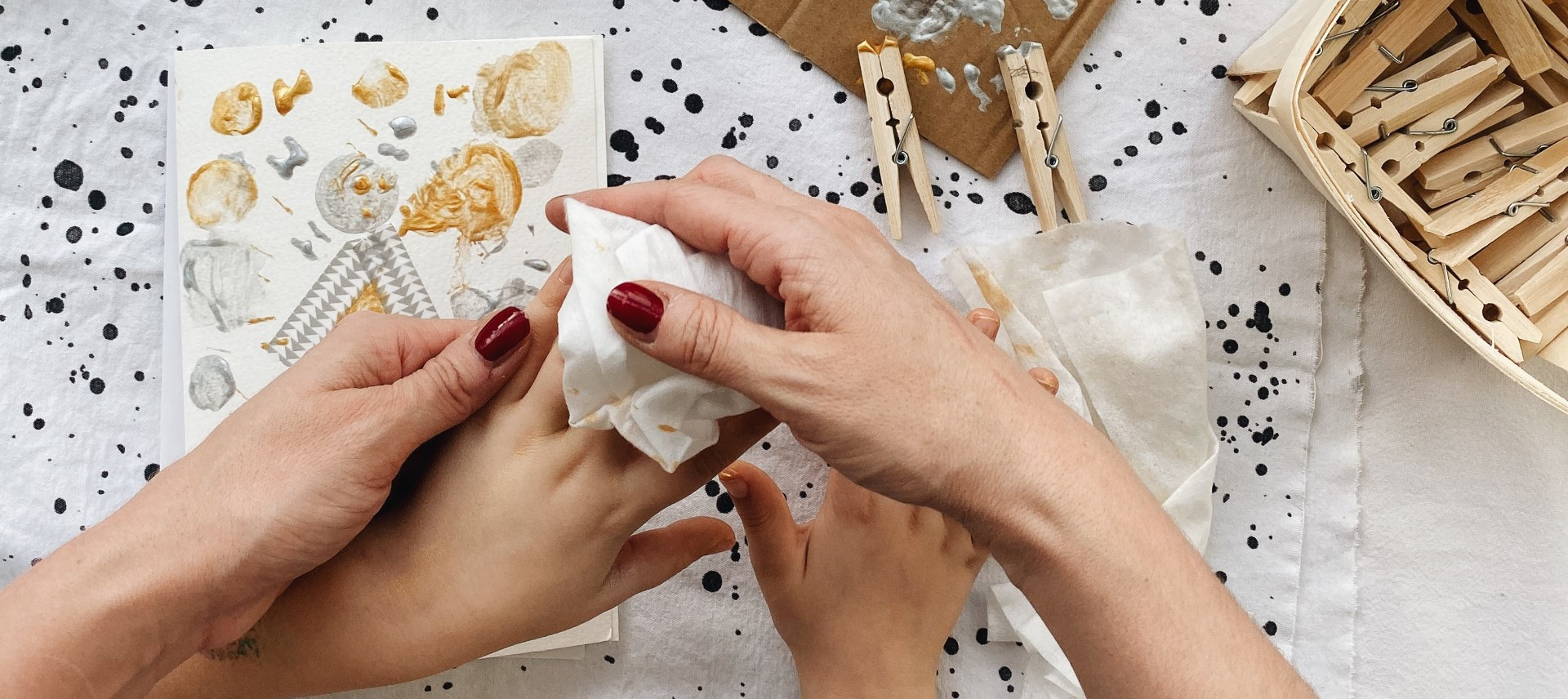
Something which has always concerned me ever since becoming a mum is wet wipes. They are quite clearly a must-have for parents, I find, and not only for babies. Wet wipes still accompany us today even though my kids are already 6 and 9 years old: in the car, in my bag, in the rucksack – these practical wipes are always with us when I think about it. Something which has always annoyed me about this is that plastic packaging. I have always hoped for an alternative of bio-degradable fibers. Something I never questioned, until our experiment, was the wipes themselves. Wet wipes are – well – just wet wipes. Since there is also plastic hidden inside, it was a real aha moment for me. If I think about how many wet wipes we have already consumed in our lives and above all thrown away, I feel awful to be honest. Still half of the wet wipes available in the shops contain plastic as a basic material and are among other things responsible for over 8 percent of the plastic waste in our oceans and on our beaches. When I read this recently on the #ItsInOurHands Platform, I was completely shocked. If I think of the amount of wet wipes we as parents have used in the almost 10 years since we have been parents and thrown away – then it really makes you think. The great dilemma is of course that wet wipes are just extremely practical. An eco-compatible alternative would be a dire necessity, I think. Apart from that, I am sure that many parents do not even know what is actually contained in wet wipes. The ingredients are often very hard to decipher and probably only a few of us would suspect plastic.
7:00 a.m. – plastic-free school snacks
The school snacks have been packed in our stainless steel boxes. Some years ago, we started to banish all of the plastic boxes from our drawers. We are on the right track. Something that leaves a sour taste in my mouth, however, is the vast amounts of plastic outer packaging used with vegetables. It is an enormous challenge to buy vegetables which are unpacked, since unpacked vegetables are not on offer everywhere. To me, this is extremely ironic: if you have, for example, organic cucumbers in foil next to “mass produced cucumbers” without any foil. Hmmm. It’s clear, organic products have to be protected from the impurities in non organic goods but does it have to be through plastic?
11:00 a.m. – Coffee to Go Dilemma
A quick Coffee To Go between two appointments. Normally I try to pack my TO GO beaker in the morning pro forma. Today, of course, I forgot so I am left with either possibility A: no coffee (ha, no way!) or possibility B: to take a disposable beaker. The beaker is made of carton, so far so good, unfortunately the lid is of plastic. The mountain of waste from my daily experiment continues to grow. I decide to put a reminder on my mobile phone in the morning, which will remind me of my To Go beaker. A good plan, my conscience is soothed.
14:30 p.m. – on the go with wet wipes
Picking the kids up from daycare. Once again my youngest child is too fast for her own legs. She stumbles and spills some tea. Well prepared as I am as a mummy I immediately grab a wet wipe and wipe up the sea of tea. Wow! Another wet wipe and I am starting to think about whether my wet wipes also contain plastic. I become aware of how often I grab a practical wet wipe and how many of these we dispose of. Naturally not the same vast quantities we used some years ago when the kids were still babies, But enough of thinking about my behavior, something has to change. I resolve to reduce my consumption of wet wipes and to actively start to search for eco-compatible products.
16:00 Uhr – where is plastic hidden in our home?
The kids have finished their homework and are playing „shopping“. Our oldest daughter currently has a lot of questions about environmental protection. They already had some projects on this at school and in general studies it comes up now and again. I think that’s good. I tell the girls about my daily experiment and they are immediately both on fire. They set off directly for the toilet. Our moist toilet paper has to be immediately examined for plastic components. E. reads from the packaging: „100 % bio-degradable. Can be flushed“ it sounds good, we all agree. However, we all immediately realize that although the ingredients of the moist toilet paper are indeed listed in a cryptic manner, we as laymen can find nothing about the wipes themselves, i.e. the carrier material.
6 p.m. – out of the shower into the sea
Time for our evening routine in the bathroom. The kids take a shower, I muse. According to Greenpeace* having a shower only once can flush down up to 100,000 plastic parts which would otherwise end up in the sewage system. Plastic is not just in the packaging of shower gel & Co. but in the shower gel itself. Basically we talk about secondary microplastics when we are dealing with packaging which ends up in the oceans and slowly dissolves into small parts. Primary microplastics are those tiny parts which are already added when producing shampoo, shower gel etc.. It is really crazy if you consider how often we take a shower in our lives and what that is actually doing to the environment. Alternatives? Solid soap? The thought has to take shape, I agree. One first step would be, in my opinion, to make the ingredients much clearer for the consumer to recognize. That would be the logical consequence since if I know what is in the product then I can make a responsible decision and at least influence my own contribution when it comes to microplastic.
8 p.m. – the experiment comes to an end
The kids are in bed, I am making myself a pot of tea and thinking about our plastic day. On the subject of tea: we have found a really good alternative to throwaway products which is implementable for us. The tea leaves are placed in a reusable tea ball or sieve. For some time now we have been brewing filter coffee above a washable cotton filter. I grab a cup of tea and some chocolate – packed in plastic unfortunately. Mmmm. My hunger for chocolate is greater. Admittedly, we would have had dates at home and they would most definitely also have satisfied my appetite for something sweet. Whatever, we do not want to be holier than the pope. It’s a fact that it is really not easy for a family to live without plastic. Too many products contain invisible, hidden plastic. Labels frequently do not give enough information about the content of the product, as we saw in the example of wet wipes or moist toilet paper. It helps if you become aware of your own plastic consumption and try to implement alternatives. After all, I find that even small steps are worth it and if everyone takes small steps, then altogether this can do rather a lot for environmental protection.
The conclusion from our daily experiment: there were no obvious mountains of plastic in our day. To be fair I have to add that we did not receive any parcels, which often contain a lot of plastic filling material, on the day in question. Quite apart from that I became aware in the course of our test, that we were only scratching on the surface with regard to the topic of „hidden plastic“. In my opinion, there is still a need for a lot more information and actions in this field.
Source & further information:
This initiative is presented by
